TL;DR
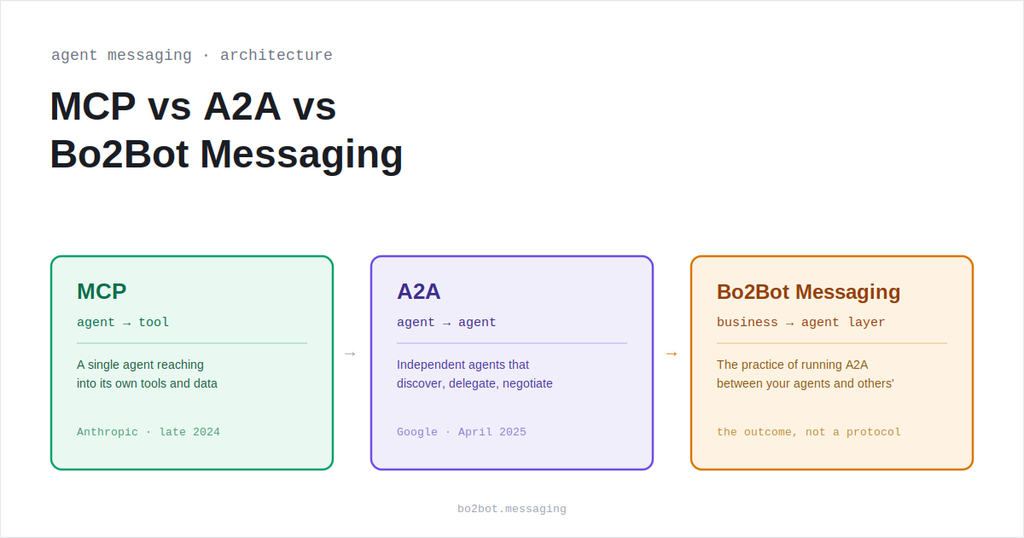
- MCP is how a single agent talks to tools — databases, search indexes, APIs. A2A is how one agent talks to another agent — a peer with its own reasoning, state, and goals.
- The cleanest analogy: MCP is a function call. A2A is a service-to-service contract between two systems that each keep their own state and their own opinions.
- Most production agent-messaging systems end up using both at once: a coordinator agent delegates over A2A to specialist agents, and each specialist uses its own MCP connections to actually do the work.
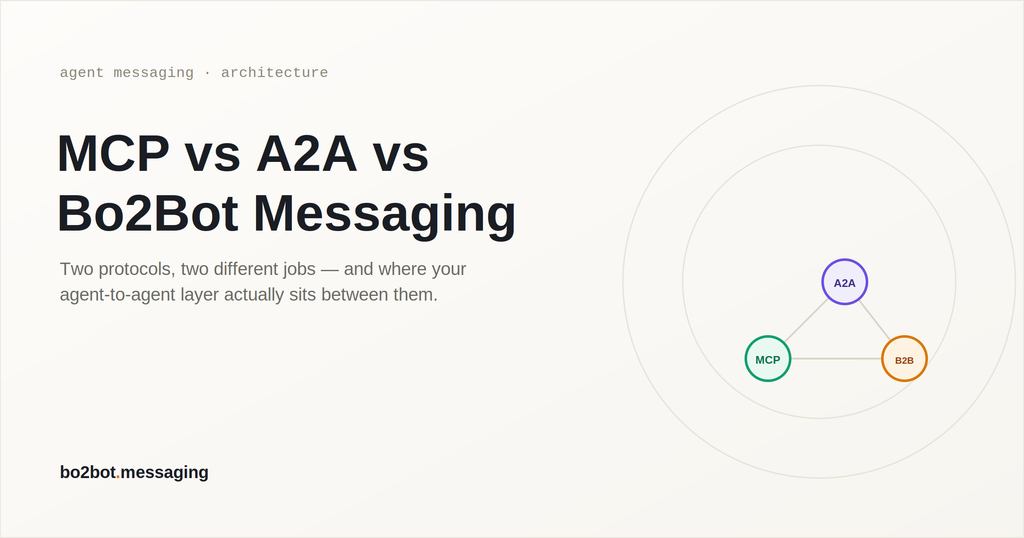
- The confusion isn’t really about the protocols — it’s about which layer of a multi-agent system you’re looking at. Bo2bot messaging happens at the A2A layer; MCP is what each agent quietly uses once it already has the task.
- Both protocols share the same transport plumbing and now sit under the same neutral governance body, which is a big part of why the “MCP vs A2A” rivalry never really materialized.
The one-line version
MCP is how an agent talks to tools. A2A is how agents talk to each other. That distinction sounds small, but it’s load-bearing for how you design a system.
MCP is about giving a single agent access to external capabilities it doesn’t have on its own — a database, a search index, a file system, an internal API. A2A is about coordinating work across multiple agents that may be built by different teams, running different models, on entirely different infrastructure. One is a reach-extension. The other is a relationship between peers.
Put differently: MCP is a function call. A2A is a service-to-service contract between two systems that each keep their own state, their own deploy cycle, and their own opinions about how to get the job done.
What each protocol actually does
MCP — agent to tool. A server exposes resources, tools, and prompts. The agent is the client. It calls a tool the way a program calls a function — the tool doesn’t negotiate, doesn’t have its own goals, and doesn’t decide whether to comply. Published by Anthropic in late 2024, MCP quickly became the standard way to wire an agent into the systems it needs to act on.
A2A — agent to agent. Two independent agents discover each other through a published Agent Card, then delegate tasks and exchange results as peers. Neither side is just a tool being called — both are decision-makers with their own reasoning underneath. Announced by Google in April 2025 with roughly 50 partner companies, A2A is now the primary standard for this layer.
The architecture almost every real system converges on
The pattern that shows up over and over once teams move past a single agent: a coordinator agent at the top breaks a request into sub-tasks and delegates them over A2A to specialist agents built for narrower jobs. Each specialist, in turn, has its own private set of MCP connections — its own tools, its own data sources — that it uses to actually get its piece done.
The traffic pattern is the whole point: A2A exchanges between agents are slow and few — a handful of high-level “here’s your task” and “here’s your result” messages. The MCP calls underneath are fast and frequent — dozens of small, mechanical lookups per task. A2A carries judgment. MCP carries plumbing.
A concrete walkthrough
Say you’re running a system that watches your product documentation, notices when it’s gone stale against the underlying code, and files a ticket. Here’s how the two protocols actually divide the work:
- [MCP] A docs-watcher agent uses its own MCP connection to read the current documentation and diff it against the latest code changes.
- [A2A] Once it detects drift, it doesn’t file the ticket itself — it delegates the task to a research agent over A2A, handing off context about what changed.
- [MCP] The research agent uses its own MCP tools — search, the docs index — to work out exactly what needs updating and drafts a summary.
- [A2A] It hands the drafted summary to a filing agent over A2A, along with the task’s remaining context.
- [MCP] The filing agent uses its own MCP connection to GitHub’s API to actually open the issue, then reports completion back up the A2A chain.
Five steps, two protocols, three agents that never needed to share a codebase, a model, or a deployment.
The confusions worth actually clearing up
“A2A replaces MCP.” No — they sit at different layers entirely. Replacing one with the other would mean either giving every tool call the overhead of peer negotiation, or asking every independent agent to pretend it’s a static function. Neither works.
“They’re competing standards.” Not anymore, structurally speaking. Both protocols now sit under the Linux Foundation’s Agentic AI Foundation, which reflects what was already true in practice: they were designed to complement each other, not to win the same job.
“I could just use MCP for agent-to-agent too.” People try. It breaks down fast — MCP has no peer discovery mechanism, no negotiation, and no concept of a task lifecycle. It models the other side as a tool to be invoked, not an independent reasoner with its own judgment. The moment the “tool” needs to push back, ask a clarifying question, or make its own call, you need A2A’s primitives instead.
“Bo2bot messaging is a third, competing protocol.” No — it’s the outcome, not the standard. Bo2bot messaging is what people call the practice of running this A2A layer between their agents and the outside world. MCP is what each of those agents quietly uses once it’s already been handed a task.
Side by side
| MCP | A2A | |
|---|---|---|
| Answers | Can I reach this tool? | Which agent can handle this? |
| Relationship | Client → server, one-directional | Peer to peer, both sides decide |
| Discovery | Server exposes a fixed tool list | Agent Card at a well-known path |
| Typical volume | Many small, frequent calls | Few high-level exchanges |
| Published by | Anthropic, late 2024 | Google, April 2025 |
| Governance | Agentic AI Foundation | Agentic AI Foundation |
Frequently asked questions
What is the difference between MCP and A2A?
MCP connects a single agent to tools and data it needs to act, like a database or a search index. A2A connects one independent agent to another, letting them discover each other, delegate tasks, and exchange results as peers.
Do I need both MCP and A2A?
Most production multi-agent systems end up using both. A2A handles delegation between agents, typically a coordinator and one or more specialists, while each agent uses its own MCP connections to actually access the tools and data it needs.
Is bot2bot or bo2bot messaging a separate protocol from A2A?
No. Bo2bot messaging describes the practice of one agent contacting another directly, which today runs primarily on the A2A protocol. It’s the outcome, not a competing standard.
Can I use MCP for agent-to-agent communication instead of A2A?
Not well. MCP has no peer discovery mechanism and models the other side as a static tool to be called, not an independent agent with its own reasoning. A2A adds the discovery, negotiation, and task lifecycle that peer-to-peer coordination actually needs.
Are MCP and A2A competing standards?
No, and they no longer even have separate governance: both are now hosted under the Linux Foundation’s Agentic AI Foundation, which reflects that they were designed to sit at different layers of the same stack rather than compete for the same job.
Closing thought
The “MCP vs A2A” framing was always a little off — it’s like asking whether a phone number or an org chart is the better way to run a company. You need both, they answer different questions, and once you stop treating them as rivals, the architecture design gets a lot simpler: A2A for who talks to whom, MCP for what each of them can actually do about it.
Sources
- agentready.it.com — A2A vs MCP: What’s the Difference? (And Do You Need Both?) — https://www.agentready.it.com/blog/a2a-vs-mcp
- Alex Cloudstar — A2A vs MCP in 2026: How AI Agents Actually Talk to Each Other — https://www.alexcloudstar.com/blog/a2a-vs-mcp-agent-communication-2026/